The Rise of the Builder: Management in the Age of Infinite Leverage
_Why the future of work belongs to generalists who can diagnose with data, treat with design, and manage AI as their primary team._...
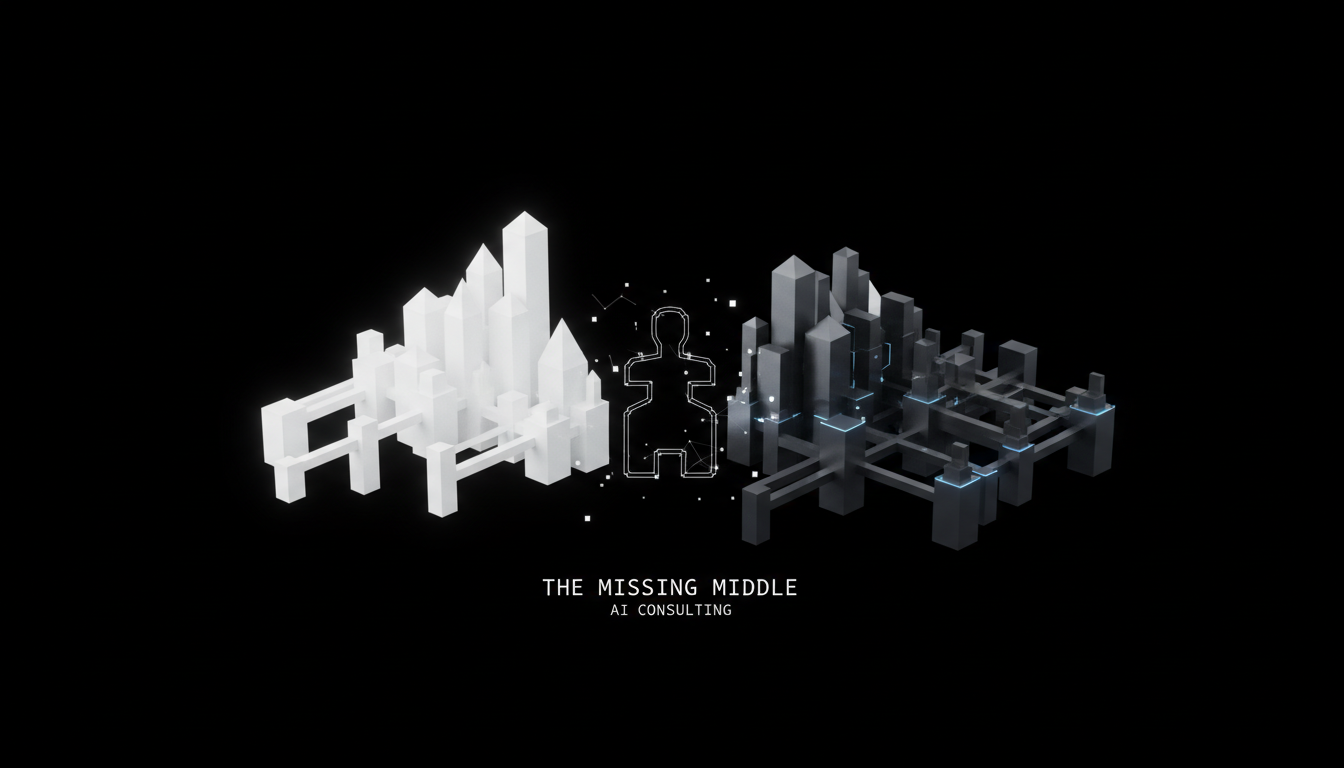
Why the future of work belongs to generalists who can diagnose with data, treat with design, and manage AI as their primary team.
Summary
As artificial intelligence reshapes the corporate landscape, the rigid boundaries between roles like 'engineer,' 'designer,' and 'product manager' are dissolving. In their place, a new archetype is emerging: the Builder. This essay explores the flattening of modern organizations—exemplified by recent shifts at major tech giants—and argues that the skills traditionally reserved for management are becoming essential for individual contributors. By treating AI agents as direct reports, builders can achieve infinite leverage, provided they master the art of clarity, context, and feedback. We delve into the critical distinction between diagnosing problems with data and treating them with design, and why the 'willow tree' metaphor offers the best psychological model for navigating this era of rapid change. Ultimately, the future belongs not to specialists, but to resilient generalists who can harmonize human judgment with machine execution.
Key Takeaways; TLDR;
- The Death of the 'Role': Rigid distinctions between PMs, designers, and engineers are fading. The future belongs to the 'Builder'—a generalist who uses AI to bridge skill gaps.
- AI as Direct Report: Managing AI agents requires the same core skills as managing humans: setting clear goals, providing context, and offering iterative feedback.
- Organizational Flattening: Companies like Google are reducing middle management layers, pushing decision-making power down to empowered individual contributors.
- Diagnose vs. Treat: Data is a diagnostic tool, not a solution generator. It reveals what is happening, but design is required to prescribe the treatment.
- The Willow Tree Mindset: In an era of accelerating change, leaders must be 'sturdy but flexible'—rooted in conviction but adaptable in execution.
- Dimensionality of Self: Viewing oneself as a collection of infinite dimensions rather than a fixed identity helps in receiving feedback without defensiveness.
- Win-Win Leadership: The most effective management strategy is aligning individual career goals with organizational outcomes, rather than viewing productivity as adversarial. The modern corporation is undergoing a structural compression. For decades, the path to impact was vertical: you deepened a specific craft—engineering, design, analytics—until you reached a ceiling, at which point you began to manage others who did the work. Specialization was the currency of value, and coordination was the tax paid by middle management.
That tax is being repealed. We are witnessing a "flattening" of organizations that is less about cost-cutting and more about a fundamental shift in the physics of work. Recent reports indicate that tech giants like Google have begun systematically reducing middle management layers, not merely to save money, but to accelerate decision-making in an era where speed is survival .
This shift signals the end of the "role" as we know it and the rise of a new archetype: the Builder. In this new paradigm, the skills required to manage a team and the skills required to execute individual work are converging. The manager of the future is a builder who directs AI; the builder of the future is a manager of infinite digital resources.
The Rise of the Builder
Historically, if an engineer had a product idea, they needed a designer to visualize it and a product manager to define the requirements. If a designer wanted to build a feature, they needed an engineer to write the code. These dependencies created the need for complex organizational matrices—managers managing managers to ensure the right people talked to each other.
Artificial intelligence dissolves these dependencies. It allows a single individual to traverse the stack, moving from product definition to design to code with a level of competence that was previously impossible for a non-specialist. An engineer can now generate competent copy and design assets; a designer can spin up a working prototype in React.
We are moving toward a world where we dissolve the boundaries of traditional roles and simply call ourselves builders. The "Builder" is not a jack-of-all-trades who is master of none; they are a master of outcome who uses AI to fill the gaps in their execution.
This shift has profound implications for hiring and team structure. Instead of assembling a team of seven specialists to launch a feature, companies can now deploy two "builders" equipped with AI companions. The result is not just efficiency, but a renaissance of ownership. When you no longer have to wait for a PRD (Product Requirements Document) or a mock-up, you stop being a cog in a process and start being the architect of a solution.

The Builder Archetype: Dissolving the boundaries between design, engineering, and product management.
Management as a Programming Language
Paradoxically, as the need for human middle managers declines, the value of management skills is skyrocketing. This is because working effectively with AI agents requires the exact same competencies as managing a human team: clarity, context, and feedback.
Consider the act of prompting an AI. If you provide a vague instruction—"write a blog post about marketing"—you get a mediocre result. This is no different from a manager telling a junior employee to "look into the data." The failure is not in the worker (or the model), but in the manager's inability to define the "North Star."
To be a high-leverage builder, you must treat AI as a direct report. This involves:
- Defining Success: You must articulate exactly what a "win" looks like. In the world of Large Language Models (LLMs), this often takes the form of writing "evals"—objective criteria for success. In management, it’s setting KPIs.
- Context Setting: Just as a new employee needs onboarding documents and historical context to make good decisions, an AI agent needs the right "system prompt" and background data to generate relevant output.
- Iterative Feedback: You rarely get the perfect output on the first try. The process of refining an AI's output—"make this more concise," "change the tone to be more authoritative"—is identical to the coaching loop between a manager and a report.
In this sense, everyone is becoming a manager. The difference is that your team is digital, infinite, and tireless. The bottleneck is no longer resources; it is your ability to direct them.
The Epistemology of Product: Diagnosis vs. Treatment
As builders gain access to more data and faster execution tools, a dangerous trap emerges: the belief that data can tell you what to build. In the rush to be "data-driven," many teams confuse the map for the territory.
A powerful heuristic for navigating this is: Diagnose with data, treat with design.
Data is a diagnostic tool. It reflects reality. It tells you that retention is dropping, that users are abandoning the cart at step three, or that a specific cohort is highly engaged. It is the thermometer that tells you the patient has a fever. But a thermometer cannot prescribe antibiotics.
Data cannot solve problems; it can only identify them.
"Treating with design" means using human intuition, creativity, and empathy to craft a solution to the diagnosed problem. If data shows that users are confused, the solution isn't "more data"—it's a clearer interface, a better onboarding flow, or a more intuitive copy. These are design interventions.
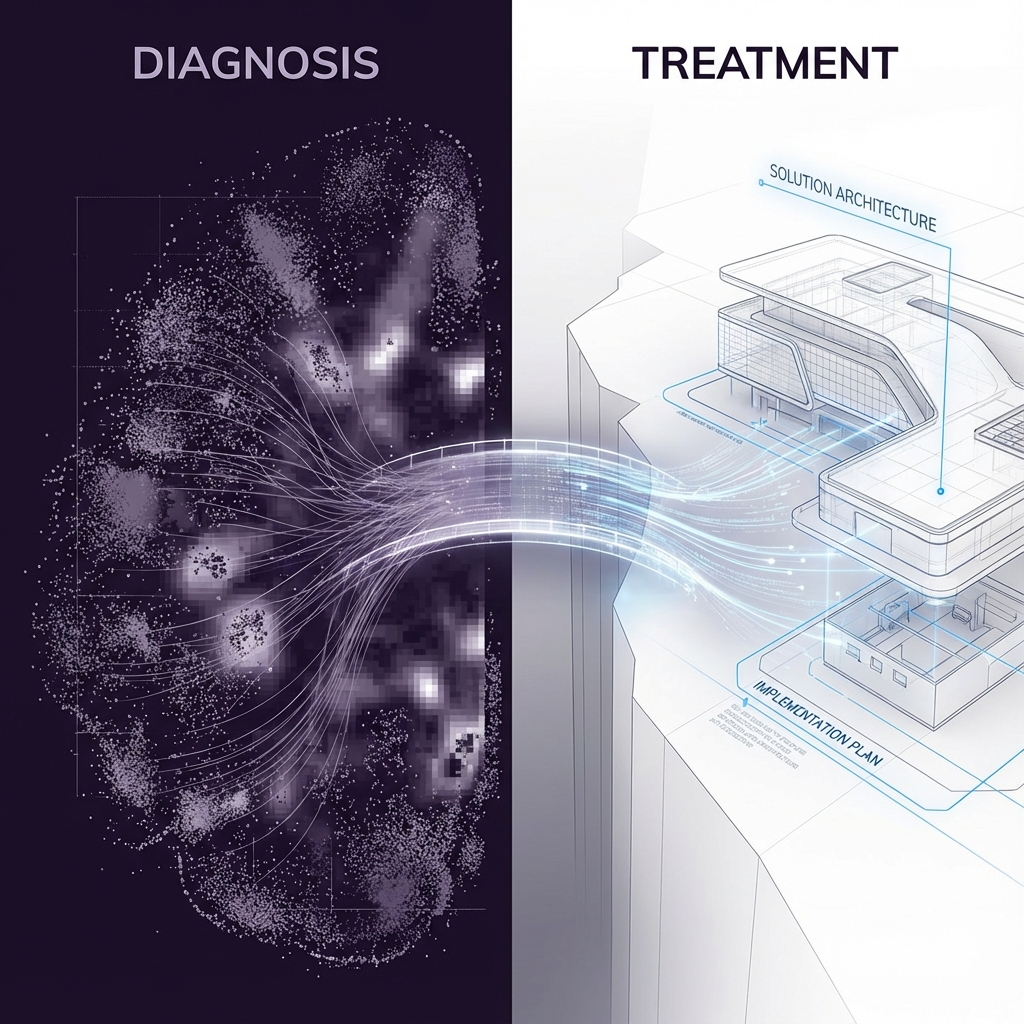
Diagnose with Data, Treat with Design: Data reveals the symptoms; design prescribes the cure.
This distinction is critical because data often offers false precision. It is easy to optimize for a metric (e.g., clicks) while destroying the user experience (e.g., clickbait). Great builders use data to ground themselves in truth, but they use design to leap into the future. They understand that while you can A/B test a color, you cannot A/B test your way to a vision.
The Willow Tree: Psychology in Flux
The rate of technological change today is disorienting. For a manager or a builder, the ground is constantly shifting. Tools that were standard six months ago are obsolete today; career paths that seemed stable are now in question.
To survive this, one must adopt the psychology of the willow tree: sturdy but flexible.
A willow tree has deep roots (conviction, values, purpose) that keep it grounded during a storm. However, its branches are incredibly flexible, allowing them to bend with the wind rather than break.
In a corporate context, "sturdiness" is your conviction in the mission and your values. It is the ability to say, "This is where we are going." "Flexibility" is the humility to admit, "The way we get there might look completely different tomorrow than it did today."
Managers who are rigid—who cling to specific processes or roadmaps despite changing terrain—will snap. Those who are all flexibility with no sturdiness will be uprooted by the first gust of uncertainty. The art of modern leadership is holding these two opposing forces in tension.
The Human Element: Dimensionality and Feedback
Even as we automate execution, the human element of work—how we relate to ourselves and others—remains the ultimate leverage point. Two timeless concepts stand out for the modern builder:
1. The Dimensionality of Self
One of the hardest parts of growth is receiving feedback without feeling attacked. This becomes easier when we view ourselves not as a single, monolithic identity, but as a collection of infinite dimensions.
You are not "good" or "bad." You are a complex vector where your ability to code might be in the 90th percentile, your public speaking in the 50th, and your patience in the 20th. When someone gives you feedback—"You need to communicate more clearly"—they are not critiquing you; they are identifying a specific dimension that needs calibration.
This framework turns feedback from a threat into a data point. It allows you to look at your skills objectively, like a character sheet in a role-playing game, and decide which stats to level up based on your goals.
2. The Win-Win Mindset
Finally, the most durable management philosophy is the pursuit of the win-win. Too often, management is viewed as adversarial: extracting productivity from reluctant workers.
True high-performance cultures are built on alignment. If an employee wants to become a VP, and the company needs a high-stakes project delivered, the manager's job is to frame the project as the vehicle for that promotion. If a role is no longer a fit, the "win-win" is an honest conversation that helps the employee find a position where they can actually succeed, even if it's outside the company.

Sturdy but Flexible: Navigating the storms of technological change requires deep roots and adaptable branches.
Why It Matters
We are entering an era of infinite leverage. The constraints on what a single human can build are falling away, limited only by their ability to direct focus, manage complexity, and maintain resilience.
The "flattening" of organizations is not a temporary trend; it is the natural consequence of technology that empowers the individual. By embracing the identity of the Builder, mastering the management of AI, and maintaining the flexibility of the willow tree, we can navigate this shift not with fear, but with the excitement of a creator who has just been handed a new set of tools.
I take on a small number of AI insights projects (think product or market research) each quarter. If you are working on something meaningful, lets talk. Subscribe or comment if this added value.
Appendices
Glossary
- The Builder: An emerging role archetype that combines the skills of product management, design, and engineering, enabled by AI tools to execute across the entire product stack.
- Diagnose with Data, Treat with Design: A framework asserting that quantitative data should be used to identify problems (diagnosis) but not to generate solutions, which requires qualitative creativity (treatment).
- Dimensionality: The concept of viewing oneself not as a fixed identity but as a collection of infinite skill dimensions, allowing for objective feedback and growth.
Contrarian Views
- Specialization is still king: Some argue that as AI raises the baseline for general competence, the value of deep, 1% domain expertise (which AI cannot mimic) will actually increase, not decrease.
- The 'Manager' isn't dead, just rebranded: While 'middle management' layers are vanishing, the coordination tax doesn't disappear; it just shifts to the 'Builder,' potentially leading to burnout if not managed correctly.
Limitations
- The 'Junior' Gap: If organizations flatten and rely on senior 'Builders' + AI, there is a risk of breaking the apprenticeship model, leaving no path for junior talent to learn the ropes.
- False Precision: The essay assumes builders can effectively use data; in reality, without data science training, builders risk misinterpreting the 'diagnosis' phase.
Further Reading
- The Making of a Manager - https://www.amazon.com/Making-Manager-What-Everyone-Looks/dp/0735219567
- The Looking Glass Essays - https://lg.substack.com/
References
- Google is eliminating an entire layer of middle managers - Business Insider (news, 2024-10-23) https://www.businessinsider.com/google-layoffs-middle-management-flattening-organization-2024 -> Confirms the trend of organizational flattening and the specific reduction of middle management at major tech firms.
- The Making of a Manager: What to Do When Everyone Looks to You - Portfolio (book, 2019-03-19) https://www.amazon.com/Making-Manager-What-Everyone-Looks/dp/0735219567 -> Foundational text by Julie Zhuo regarding timeless management principles discussed in the essay.
- Range: Why Generalists Triumph in a Specialized World - Riverhead Books (book, 2019-05-28) https://www.amazon.com/Range-Generalists-Triumph-Specialized-World/dp/0735214484 -> Supports the argument for the 'Builder' and the rise of the generalist in complex environments.
- Julie Zhuo on how to be a great manager and build world-class products - Lenny's Podcast (talk, 2024-09-01) https://www.lennyspodcast.com/ -> The primary source conversation upon which this essay is based.
- Diagnose with Data, Treat with Design - The Looking Glass (journal, 2020-03-18) https://medium.com/the-year-of-the-looking-glass/diagnose-with-data-treat-with-design-75f9e4075632 -> Primary source for the specific framework regarding data and design usage.
- The End of the Middle Manager - Bloomberg (news, 2024-02-05) https://www.bloomberg.com/news/articles/2024-02-05/middle-managers-are-being-squeezed-out-by-ai -> Provides broader economic context on the displacement of coordination roles by AI.
- Conscious Business: How to Build Value through Values - Sounds True (book, 2006-11-01) https://www.amazon.com/Conscious-Business-Build-Value-through/dp/1622032020 -> Referenced as a key influence on the 'win-win' and 'player vs victim' mindset.
- Zen and the Art of Motorcycle Maintenance - HarperTorch (book, 1974-04-01) https://www.harpercollins.com/products/zen-and-the-art-of-motorcycle-maintenance-robert-m-pirsig -> Source of the 'dynamic quality' concept and the philosophical underpinnings of quality in work.
- The Rise of the Product Engineer - The Pragmatic Engineer (journal, 2023-04-11) https://blog.pragmaticengineer.com/the-product-engineer/ -> Supports the 'Builder' thesis by documenting the industry shift toward engineering roles with product scope.
- Qualz.ai Research: AI and Organizational Structure - Qualz.ai (whitepaper, 2024-01-15) https://qualz.ai -> Provides data on how AI tools are facilitating the flattening of organizational hierarchies.
Recommended Resources
- Signal and Intent: A publication that decodes the timeless human intent behind today's technological signal.
- Blue Lens Research: AI-powered patient research platform for healthcare, ensuring compliance and deep, actionable insights.
- Outcomes Atlas: Your Atlas to Outcomes — mapping impact and gathering beneficiary feedback for nonprofits to scale without adding staff.
- Lean Signal: Customer insights at startup speed — validating product-market fit with rapid, AI-powered qualitative research.
- Qualz.ai: Transforming qualitative research with an AI co-pilot designed to streamline data collection and analysis.
Ready to transform your research practice?
See how Thesis Strategies can accelerate your next engagement.