OpenAI's Sora: More Than a Video Generator, It's a World Simulator
_Sora isn't just about creating clips; it's a foundational step toward AI that understands and simulates our physical reality. This has profound implications fo...
Sora isn't just about creating clips; it's a foundational step toward AI that understands and simulates our physical reality. This has profound implications for creativity, social media, and even science.
Published: 2025-11-15
Summary
OpenAI's Sora represents a significant leap in generative AI, moving beyond simple video creation toward the development of 'world simulators'—models that build an internal understanding of physics and object permanence. This capability stems from its core architecture, the Diffusion Transformer (DiT), which processes video as holistic 'space-time patches' rather than frame by frame. As these models scale, they exhibit emergent properties, such as respecting physical laws in their simulations, a crucial step toward more intelligent and reliable AI. Parallel to this technical achievement, OpenAI's social application of Sora is a deliberate experiment in platform design, prioritizing active creation and remixing over passive consumption. By learning from the pitfalls of traditional social media algorithms, the team aims to build an ecosystem that fosters a net increase in human creativity. This dual focus on foundational research and thoughtful deployment signals a future where AI not only democratizes content creation but also serves as a tool for scientific discovery and complex simulation.
Key Takeaways
- Sora is built on Diffusion Transformers (DiTs), which process entire videos at once using 'space-time patches,' enabling a more coherent understanding of motion and object permanence.
- Unlike previous models, Sora shows emergent understanding of physics. For example, it will simulate a basketball realistically bouncing off a rim rather than magically forcing it into the hoop to satisfy a prompt.
- OpenAI views Sora's development as an iterative process, comparing Sora 1 to GPT-1 and the current version to GPT-3.5—a major step in usability and capability.
- The Sora social app is intentionally designed to optimize for user creation rather than passive consumption, a direct response to lessons learned from platforms like Instagram.
- Features like 'Cameos' and 'Remixes' dramatically lower the barrier to entry for creativity, making nearly every user a creator.
- The long-term vision for Sora extends beyond entertainment to become a general-purpose world simulator, potentially enabling scientific experiments and complex simulations within the model itself.
- OpenAI's strategy is to 'co-evolve' the technology with society through iterative deployment, allowing for gradual adaptation and feedback.
- While video data is less information-dense per bit than text, its sheer volume provides a vast frontier for training more capable world models.
- The ultimate goal is a future where personalized 'digital clones' can interact and perform tasks in a simulated environment, blurring the lines between entertainment and utility.
Article
The Dawn of the World Simulator
When we see a video generated by artificial intelligence, our first instinct is to judge its realism, its coherence, or its artistic flair. But with OpenAI's Sora, the most profound development isn't just the quality of the video output; it's what the model must understand about the world to create it. Sora is not merely a video generator. It is an early-stage world simulator—a system that, through the process of learning to predict pixels, is building an internal, intuitive model of physics, object permanence, and causality.
This shift from content generation to world simulation has far-reaching implications. It reframes the technology from a clever tool for artists and meme-makers into a foundational platform for creativity, scientific discovery, and new forms of social interaction. OpenAI's approach is twofold: push the boundaries of the core technology while simultaneously deploying it in a social application designed to co-evolve with society, avoiding the pitfalls of the last generation of social media.
The Engine of Reality: How Sora Works
To understand Sora, we have to look past the familiar architecture of language models like GPT. While large language models (LLMs) use an autoregressive approach—predicting the next word based on the previous ones—Sora is built on a different concept: the Diffusion Transformer (DiT) .
Diffusion models work by taking a clear signal (in this case, a video) and systematically adding noise until it becomes random static. Then, a neural network is trained to reverse the process: to denoise the static, step-by-step, back into the original video. Instead of generating a video token by token or frame by frame, it generates the entire clip simultaneously, gradually refining it from noise into a coherent whole.
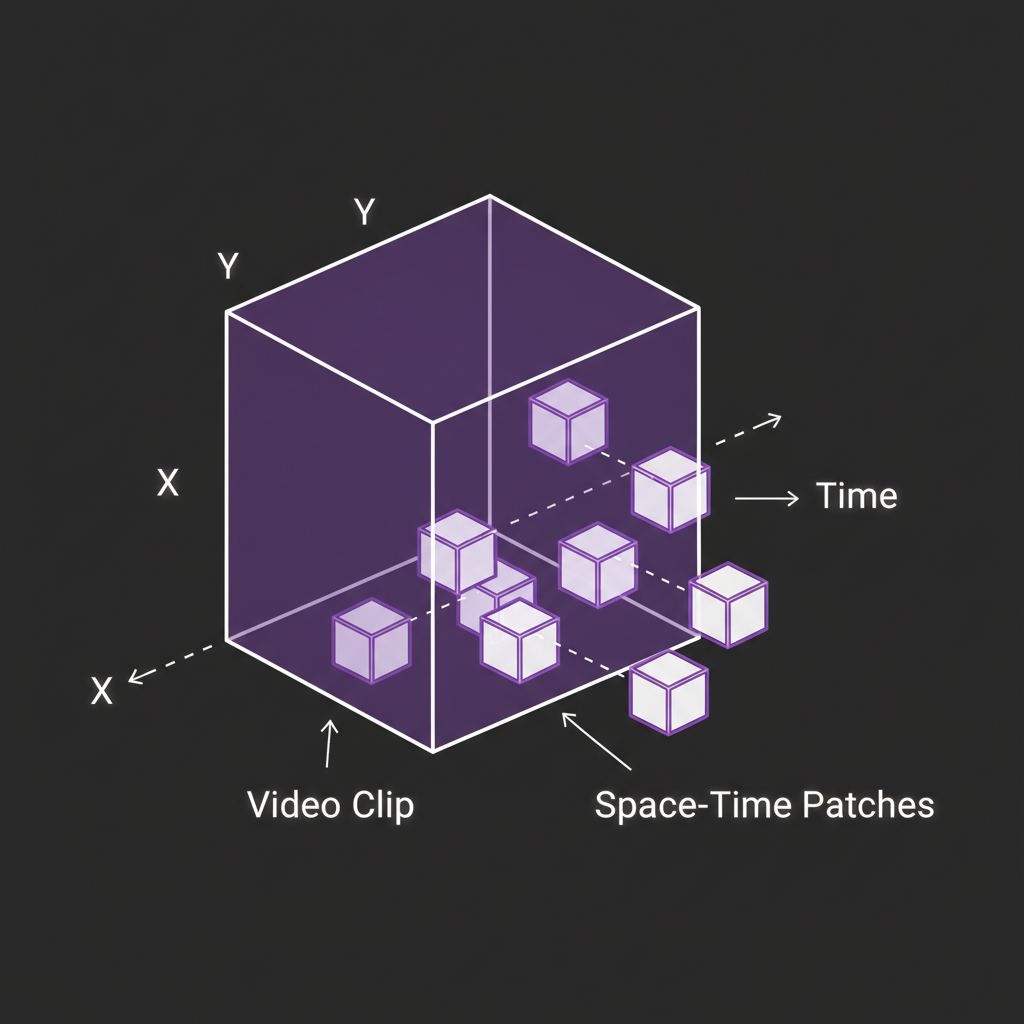
Sora processes video not as a sequence of frames, but as a unified block of space-time, allowing it to understand motion and context holistically.
The key innovation is how Sora represents video data. It breaks a video down into a collection of what the researchers call space-time patches or tokens. Imagine a video as a cube, with two spatial dimensions (width and height) and one temporal dimension (time). A space-time patch is a small cuboid from this larger block. This approach treats space and time as a unified whole, allowing the model's attention mechanism to connect information across the entire video at once.
This is crucial. When a model can see every part of the video simultaneously, it can learn that an object disappearing behind a pillar should reappear on the other side. This global context is how properties like object permanence—a concept infants take months to grasp—begin to emerge naturally from the training process, without being explicitly programmed .
From Glitches to Physics: The Emergence of Understanding
The journey from the first version of Sora to the current one marks a significant leap in the model's simulated reality. The team at OpenAI draws an analogy to their language models: Sora 1 was a "GPT-1 moment" for video, proving the concept worked. The current iteration is more like a "GPT-3.5 moment"—a breakthrough in capability and usability that has captured the public's imagination.
This improvement isn't just a matter of scaling up compute and data. It's about the quality of the simulation. A fascinating example illustrates this point: if you prompt an earlier model with "a basketball player shoots a free throw," it might generate a video where the ball magically swerves into the hoop, prioritizing the user's request over physical reality. Sora, however, is more likely to defer to the laws of physics. If the simulated shot is off, the ball will bounce realistically off the backboard or rim.
This distinction between a model failure (not doing what the user asked) and an agent failure (the simulated person missing the shot) is a profound indicator of an emerging internal world model. The system is learning that the rules of the simulated world are more important than slavishly adhering to the prompt. These physical intuitions are not hard-coded; they are emergent properties that arise once the model reaches a certain threshold of scale and is trained on vast amounts of video data depicting the real world.
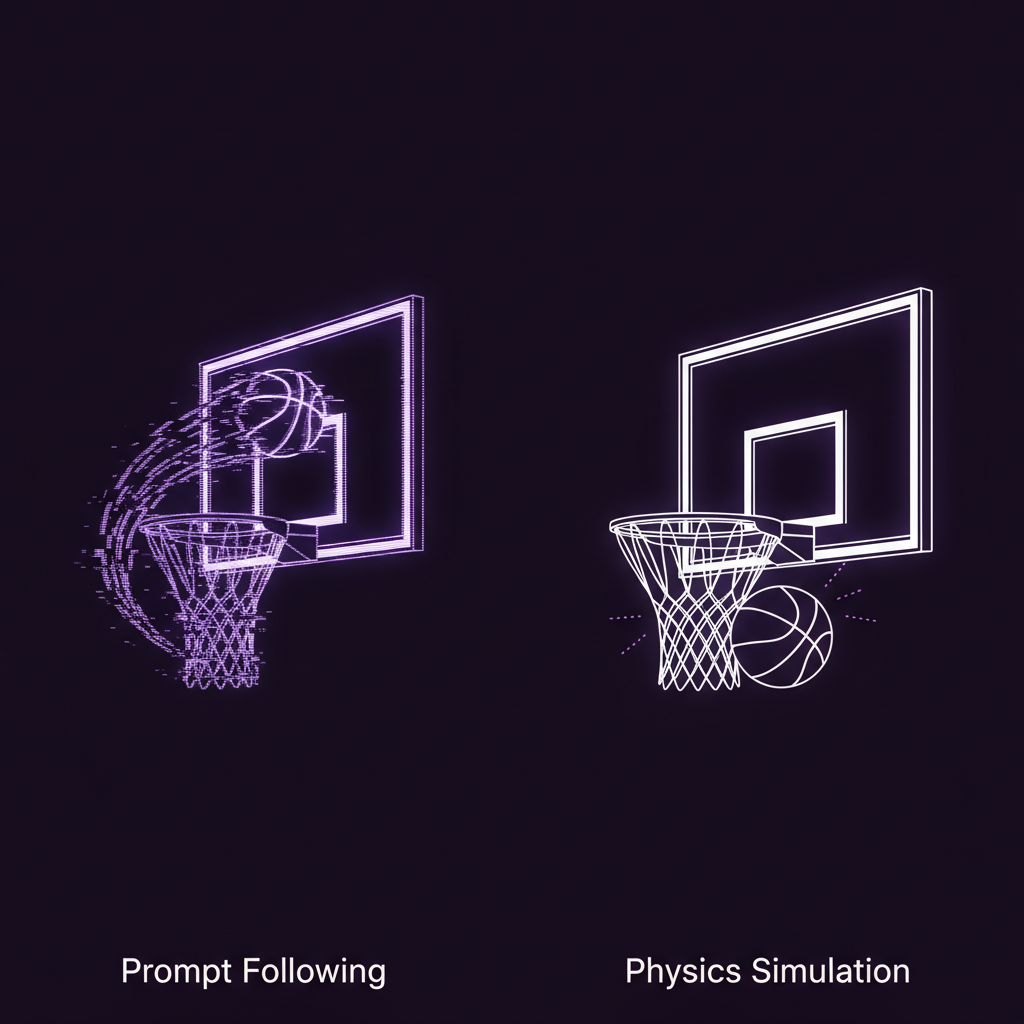
Sora's advancement is shown in its failures: it increasingly defers to realistic physics rather than simply fulfilling a prompt's request.
Of course, the training data isn't limited to real-world footage. It includes everything from cartoons to anime. While a flying dragon in an anime scene may not teach the model aerodynamics, it still provides useful data on simpler concepts like locomotion and object interaction. The model learns to generalize the fundamental patterns of movement and causality that apply across different visual styles, putting immense optimization pressure on it to develop a robust, core understanding of how things work.
A New Philosophy for Social Platforms
Building a powerful world simulator is only half the story. How you introduce it to the world matters just as much. With Sora, OpenAI launched a consumer-facing social app, but with a design philosophy that consciously diverges from the dominant models of the past decade.
The team, which includes veterans from Instagram, learned a critical lesson from the evolution of social media feeds. In the early days of chronological feeds, anyone who posted was guaranteed the top slot for their followers. This created an incentive for high-volume creators—brands, media companies, and influencers—to post constantly. Over time, this professional content crowded out the personal updates from friends and family that formed the platform's original appeal .
The solution was the algorithmic feed, which permutes content to show users what the platform predicts they care about most. While this solved the crowding-out problem, it created a new one: an optimization race for engagement at all costs. The incentive shifted from sharing to capturing attention, often leading to a firehose of mindless consumption.
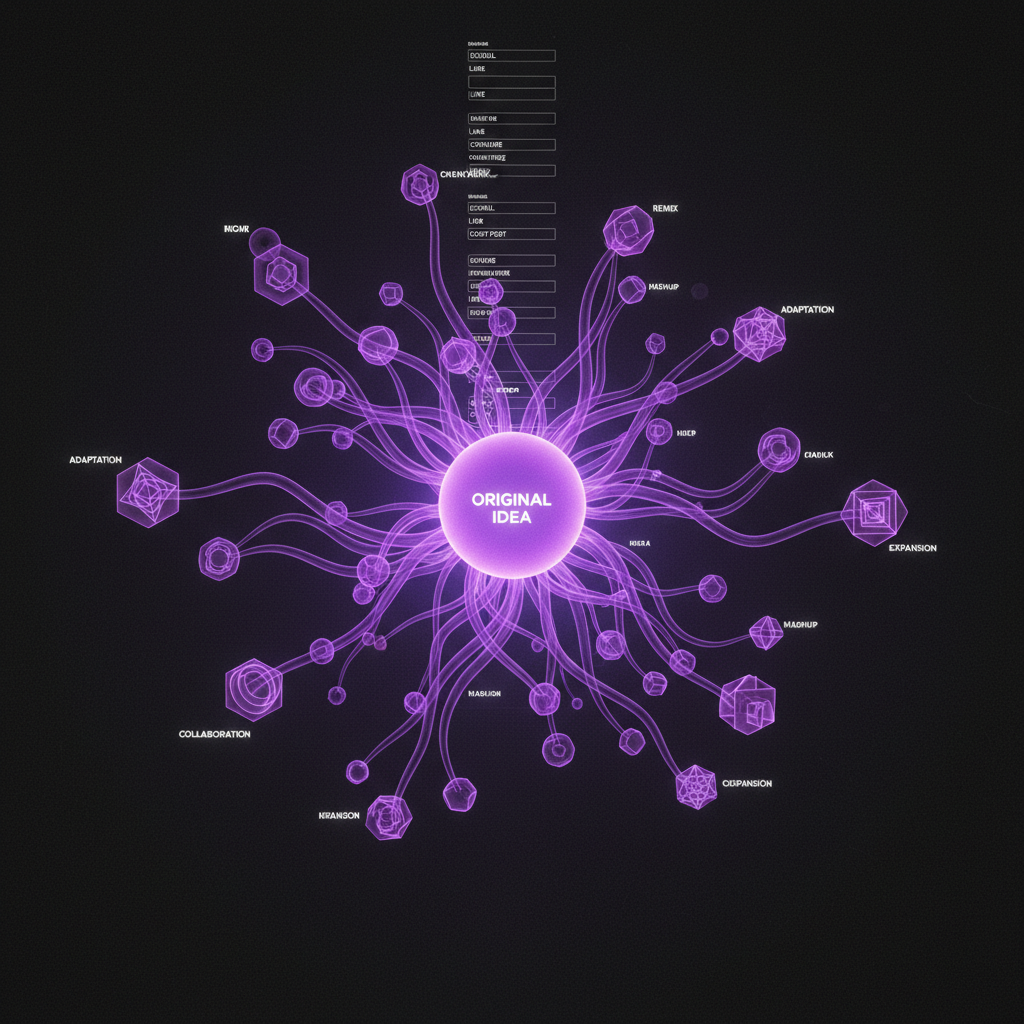
Unlike traditional feeds that optimize for passive scrolling, Sora's platform is designed to encourage remixing and active creation.
Optimizing for Creation, Not Consumption
The Sora app is an experiment in reversing this dynamic. Its primary goal is not to maximize time spent scrolling but to inspire creation. The magic of generative AI is that it dramatically lowers the barrier to entry. Anyone can be a creator, not just those with cameras, editing software, or artistic talent.
This philosophy is embedded in the product's core features:
- Cameos: Users can easily insert themselves or their friends into any scene, instantly personalizing the content and making it social.
- Remixes: Any creation can be a starting point for someone else. This fosters a collaborative, meme-like culture where ideas evolve and spread through participation, not just passive viewing.
The results are striking. According to the team, nearly 100% of new users create something on their first day, and a significant portion post their creations to the public feed. The platform is designed to break the hypnotic scroll. It might, for instance, inject a prompt into the feed suggesting you try creating something similar to what you've just watched, nudging you from a consumptive state to a creative one. This approach is a deliberate counterpoint to what design theorist Natasha Dow Schüll calls the "machine zone" in casinos, where environments are engineered to eliminate decision points and encourage a continuous, trance-like state of play .
The Co-Evolution of Society and Simulation
OpenAI's strategy is one of iterative deployment. Rather than developing a perfect, god-like world simulator in secret and dropping it on an unprepared world, they are releasing it in stages. This allows society to get comfortable with the technology, understand its capabilities, and collectively establish norms and rules of the road.
This is especially important given the long-term vision. Today, Sora is used for entertainment, but its future applications are far broader:
- Democratizing Filmmaking: The tools to create feature-length films will eventually be accessible to anyone with an idea. The next great director might be a teenager in their bedroom, no longer constrained by the economics of film production.
- Scientific Discovery: A sufficiently advanced world simulator could become a virtual laboratory. Imagine running biological experiments or testing theories of fluid dynamics entirely within the model. Just as Eadweard Muybridge's 19th-century motion studies of a galloping horse settled a scientific debate , future simulations could unlock discoveries about our world that are currently invisible.
- Digital Clones: The 'Cameo' feature is the lowest-bandwidth way of giving the model information about yourself. In the future, these models could develop a deep understanding of an individual's appearance, voice, relationships, and knowledge. This leads to a world of 'digital clones'—persistent, autonomous versions of ourselves that can interact, perform knowledge work, and exist in a mini-alternate reality running on our devices.
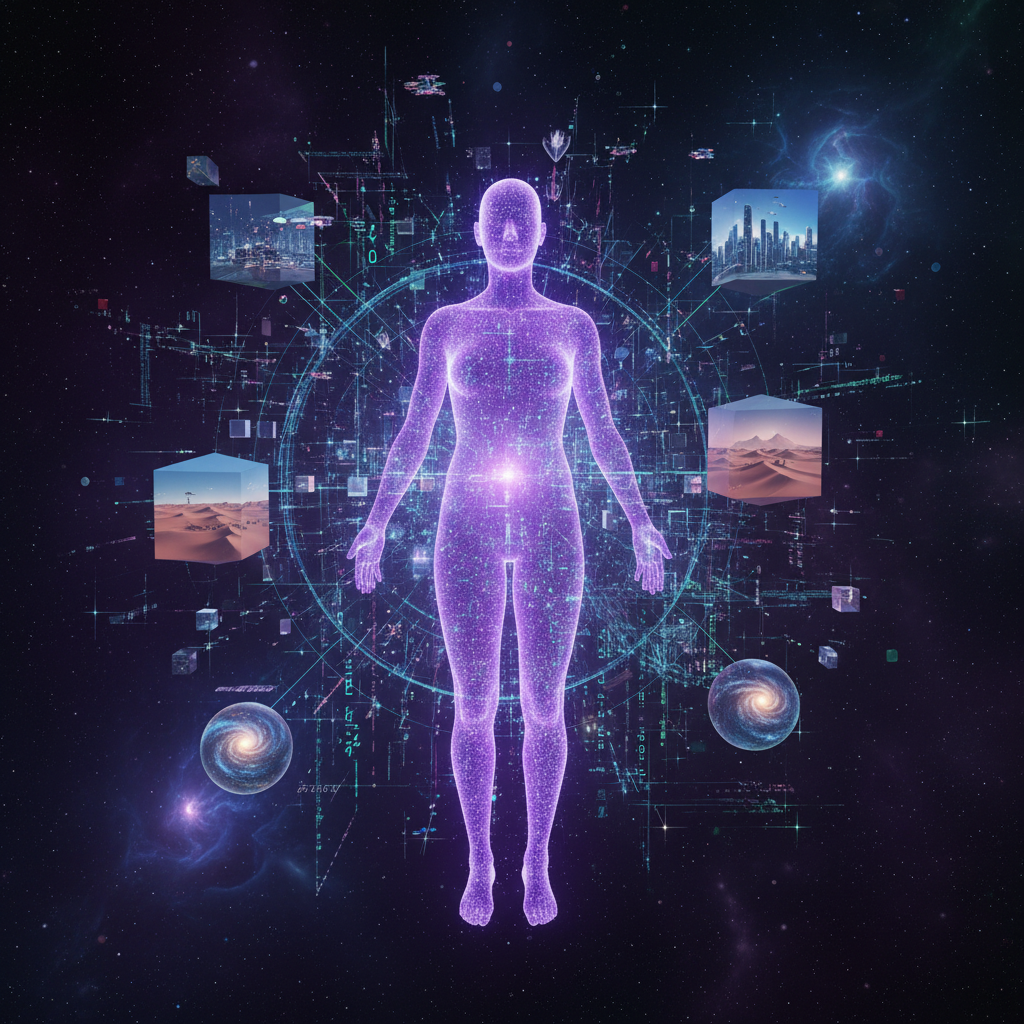
The long-term vision for Sora extends beyond video into a platform for complex simulation and personalized 'digital clones'.
This is the ultimate destination: Sora evolves from a social app into a platform—a multiverse in your pocket. That future is both exhilarating and unnerving, which is precisely why a gradual, open deployment is so critical.
Why It Matters
Sora is a milestone not just for its technical prowess but for the paradigm it represents. It is a tangible step toward AI that doesn't just process human language but understands the physical world we inhabit. The emergent ability to simulate physics from raw video data is a powerful testament to the scaling laws that govern modern AI.
Simultaneously, the thoughtful product philosophy behind the Sora app offers a hopeful alternative to the engagement-at-all-costs model of social media. By building a system that values creation, participation, and human connection, it suggests that our most powerful technologies can be designed to augment our creativity rather than simply capture our attention.
The path ahead is long. Video generation remains computationally expensive, and the models are still far from perfect simulators. But the trajectory is clear. We are at the beginning of a new era where the line between observing reality and creating it will continue to blur, powered by machines that are learning to dream our world into existence.
Citations
- Scalable Diffusion Models with Transformers - arXiv (whitepaper, 2022-12-19) https://arxiv.org/abs/2212.09748
- This is the foundational paper by William (Bill) Peebles and Saining Xie that introduced the Diffusion Transformer (DiT) architecture, which is the core technology behind Sora.
- Video generation models as world simulators - OpenAI (org, 2024-02-15) https://openai.com/research/video-generation-models-as-world-simulators
- OpenAI's technical blog post introducing the first version of Sora, which explicitly frames the technology as a 'world simulator' and discusses emergent properties like 3D consistency and object permanence.
- Instagram's new feed: what you need to know - The Verge (news, 2016-03-15) https://www.theverge.com/2016/3/15/11241396/instagram-feed-algorithm-changes
- Contemporary news report explaining Instagram's shift from a chronological to an algorithmic feed, corroborating the speaker's explanation of the motivations behind the change.
- Addiction by Design: Machine Gambling in Las Vegas - Princeton University Press (book, 2012-10-28) https://press.princeton.edu/books/paperback/9780691160887/addiction-by-design
- This book by Natasha Dow Schüll is the likely source for the 'curvilinear nature of casinos' concept, which she calls the 'machine zone.' It describes how environments are designed to facilitate uninterrupted, compulsive engagement.
- The Horse in Motion - Britannica (org, 2024-09-20) https://www.britannica.com/topic/The-Horse-in-Motion
- Verifies the historical account of Eadweard Muybridge's photographic experiment to determine whether a horse's four hooves are ever simultaneously off the ground during a gallop, a classic example of new media enabling scientific discovery.
- OpenAI's Sora App Is a Social Network That Puts Creation First - Wired (news, 2024-10-09) https://www.wired.com/story/openai-sora-app-social-network-creation-first/
- Provides third-party context and analysis of the Sora app's launch and its product philosophy centered on creation and remixing, supporting the claims made in the transcript.
- The Attention Economy and the Digital Commons - Centre for International Governance Innovation (org, 2019-06-18) https://www.cigionline.org/articles/attention-economy-and-digital-commons/
- Provides broader academic context on the 'attention economy' that algorithmic feeds on platforms like Instagram helped create, supporting the discussion of optimizing for consumption.
- Emergent Abilities of Large Language Models - arXiv (whitepaper, 2022-06-15) https://arxiv.org/abs/2206.07682
- While focused on LLMs, this paper formalizes the concept of 'emergent abilities' in large models—abilities not present in smaller models that arise at scale. This supports the claim that Sora's understanding of physics is an emergent property.
- Sora: A Review of OpenAI’s Video Generation Model - AssemblyAI (whitepaper, 2024-02-22) https://www.assemblyai.com/blog/sora-a-review-of-openais-video-generation-model/
- An accessible technical breakdown of Sora's architecture and capabilities, providing further detail on concepts like space-time patches and the model's ability to simulate physical properties.
- A conversation with the OpenAI Sora team - Sequoia Capital (video, 2024-10-10)
- The primary source for the article's core ideas, arguments, and quotes from the Sora team.
Appendices
Glossary
- Diffusion Transformer (DiT): A neural network architecture that combines the principles of diffusion models (generating data by progressively removing noise) with the power of transformers (which excel at processing sequential data using attention mechanisms). It is the core technology behind Sora.
- Autoregressive Model: A type of generative model that creates sequences one element at a time, where each new element is conditioned on all the preceding ones. Most large language models, like GPT, are autoregressive.
- Space-Time Patch: A small, cuboid-like chunk of a video that contains information across both spatial dimensions (height and width) and the temporal dimension (time). Sora processes video as a collection of these patches.
- Emergent Properties: In AI, these are complex behaviors or capabilities that arise in large models as they are scaled up, without being explicitly programmed. Examples include object permanence or a basic understanding of physics in Sora.
- World Simulator: A term for an AI model that develops a comprehensive, internal representation of the rules and dynamics of the real world (e.g., physics, causality) in order to generate realistic data.
Contrarian Views
- The claim that Sora is a 'world simulator' may be an overstatement. The model is pattern-matching on a massive scale, and its 'understanding' of physics is an interpolation of its training data, not a true causal model. It may fail unpredictably in scenarios not well-represented in the data.
- Optimizing a social platform for 'creation' does not automatically make it healthier. It could lead to new forms of social pressure, competitive burnout among creators, and an overwhelming flood of low-quality, derivative content.
- The 'iterative deployment' strategy, while framed as responsible, could also be seen as a way to normalize disruptive technology and capture market share before society can fully grapple with its negative externalities, such as misinformation or job displacement.
Limitations
- Video generation is extremely computationally expensive, which currently limits accessibility, generation length, and latency. This economic reality will be a major barrier to democratizing high-end creation.
- The model's understanding of complex physics and cause-and-effect is still brittle. It can struggle with intricate interactions, long-term consistency, and generating physically implausible scenarios.
- The reliance on existing video data for training means the model may inherit and amplify biases, stereotypes, and copyrighted styles present in the dataset, raising significant ethical and legal challenges.
Further Reading
- Attention Is All You Need - https://arxiv.org/abs/1706.03762
- The Age of AI has begun - https://www.gatesnotes.com/The-Age-of-AI-Has-Begun
- Generative AI's Act Two - https://www.sequoiacap.com/article/generative-ai-act-two/
Research TODO
- The video URL is missing. I need to find the original video from Sequoia Capital's 'Trading Data' series featuring the OpenAI Sora team, likely from October 2024, to complete citation .
Recommended Resources
- Signal and Intent: A publication that decodes the timeless human intent behind today's technological signal.
- Blue Lens Research: AI-powered patient research platform for healthcare, ensuring compliance and deep, actionable insights.
- Outcomes Atlas: Your Atlas to Outcomes — mapping impact and gathering beneficiary feedback for nonprofits to scale without adding staff.
- Lean Signal: Customer insights at startup speed — validating product-market fit with rapid, AI-powered qualitative research.
- Qualz.ai: Transforming qualitative research with an AI co-pilot designed to streamline data collection and analysis.
Ready to transform your research practice?
See how Thesis Strategies can accelerate your next engagement.